

Wall Mount Barriers
A retractable belt barrier that screws to the wall instead of standing on a post. It costs nothing in floor space, nobody can knock it over or carry it off, and the belt winds back into the housing when the run is not in use.
This is what ends up in warehouse doorways, loading bays, lift lobbies, corridors and narrow checkout aisles — anywhere a floor-standing post would be in the way or would not survive a pallet jack. Each unit comes with the receiver bracket for the far side and the fixings to mount it.
Several belt lengths, in a stainless housing. The longer belts are the ones used for safety and exclusion zones rather than queues — each product page gives the length.
Wholesale and retail · Screws to the wall · Indoor use · Scroll down for the full range
- Product
- Qty in Cart
- Quantity
- Price
- Subtotal
-

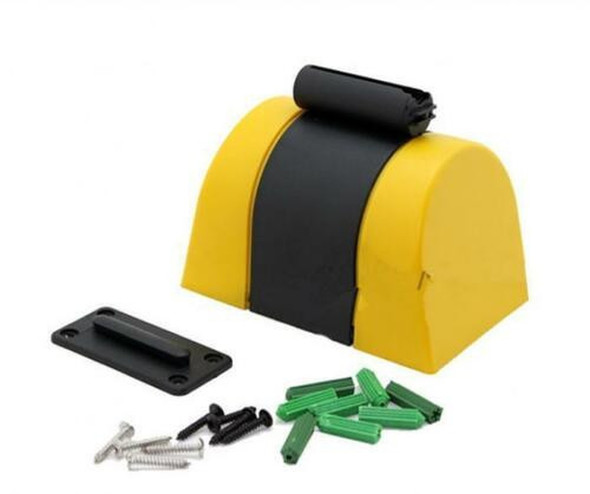
Wall Mounted Retractable Belt Barrier - 10m Black and Yellow Belt
TLT Retail Display
$68.00This is the 10 m unit with the black and yellow belt. Also in 3 m stainless red,$68.00 -


Wall Mounted Retractable Belt Barrier - 5m Black and Yellow Belt
TLT Retail Display
$48.00This is the 5 m unit with the black and yellow belt. Also in 3 m stainless red,$48.00 -


Wall Mounted Retractable Belt Barrier - 3m Black and Yellow Belt
TLT Retail Display
$42.00This is the 3 m unit with the black and yellow belt. Also in 3 m stainless red,$42.00 -


Wall Mounted Retractable Belt Barrier - 3m Red Belt, Stainless Steel
TLT Retail Display
$42.00This is the 3 m unit with the red belt. Also in 3 m black yellow,$42.00
The case for putting it on the wall
A wall-mounted barrier does the same job as a post, minus the post. That removes three problems at once.
It takes no floor space, which is the whole point in a doorway, a corridor or an aisle that is already narrow. It cannot be knocked over, because there is nothing standing up to knock. And it cannot be carried off, which matters in a loading bay, a car park or anywhere unsupervised.
The trade is that it is fixed. A post can be moved when the layout changes; a wall unit stays where you drilled it. So these suit boundaries that do not move: the same doorway closed every night, the same walkway blocked during deliveries, the same plant room staff should not enter.
Both ends need a plan
A belt has to clip into something at the far end. That is the part people forget when they measure.
The unit comes with a receiver for the opposite wall, which is the usual arrangement: housing on one side of a doorway, receiver on the other. Where there is no wall opposite and the barrier crosses an open space, you need something on that side to receive the clip, and that is worth working out before ordering rather than after.
Measure the gap, then choose a belt comfortably longer than it. A belt stretched to its limit pulls out of the receiver whenever something brushes it.
Choosing the belt length
The lengths here cover two quite different jobs.
A short belt closes a doorway, a till lane, a stairwell or a single aisle. It is the everyday one, and it retracts out of sight when the passage is open.
A long belt is for cordoning rather than closing: a work area during maintenance, a section of warehouse floor, a spill, a zone around a forklift route. These are longer runs, usually temporary, and usually about safety rather than traffic flow.
Hazard colours mean something
Black-and-yellow is the international convention for hazard, pay attention. It is not decoration and it should not be used for ordinary queue management, because that dilutes the meaning in the one place you need it to work.
Keep the hazard colour for actual hazards: maintenance, wet floors, machinery, restricted plant areas. Use a plain colour for everything else. Staff and visitors both read the difference without being told, which is exactly what you want when something is genuinely dangerous.
Mounting
Fix it to something solid. A belt under tension pulls, and a housing mounted into plasterboard alone will eventually come out of the wall with a hole behind it. Find a stud, use masonry fixings, or mount it to a frame.
Mount both ends at the same height, and at a height that reads as a barrier — around waist level for a boundary people should not cross. Too low reads as a trip hazard; too high and people duck under it.
Wall mounted barrier FAQ
Does it come with the fixings?
The unit is supplied with the receiver for the opposite side and fixings in the box. Whether those suit your wall is a separate question, because masonry, plasterboard and steel each need a different approach.
Can I mount it outdoors?
These are indoor units. The cassette is not sealed against weather, and wind on an extended belt pulls hard on a wall fixing.
What happens if someone walks into the belt?
The clip releases and the belt retracts, the same as a post-mounted barrier. It is a visual boundary rather than a restraint.
Can I use it with posts I already own?
The clip and receiver style is usually the same across standard barrier systems, so a wall unit often ends a run of posts neatly. Check the receiver before assuming it, and test one if the posts came from elsewhere.
What if the boundary needs to move?
Then it should be on a post. See the retractable belt barriers for freestanding versions, or the rope barriers where the line stands in one place and looks formal. Everything is under queue barriers and crowd control.