
Ropes & Accessories
Everything that goes with a barrier run, sold separately so a line is easy to extend, recolour or repair without replacing posts.
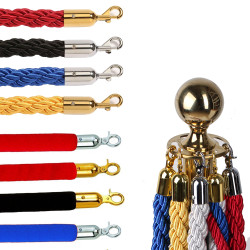
Ropes come in two lengths, and the two use different clip sizes — so match the rope to the ring on your post rather than the other way round, and check the product page before you order. Rope colours run from black and red through gold, silver, blue, green, purple and mixed, with silver or gold ends. Our ropes are braided, which holds its shape and colour better than the alternatives; velvet can be ordered in if a room calls for it, and we make ropes to order in a colour or length we do not stock.
The rest: replacement clip ends, so a broken clip does not cost you a whole rope. Wall hooks in chrome and gold, for finishing a run against a wall instead of standing a post there. Sign holders that slide onto the top of a belt post. Replacement weighted bases and replacement belt cassettes.
Wholesale and retail · Ropes, clips, hooks and spares · Indoor use · Scroll down for the full range
- Product
- Qty in Cart
- Quantity
- Price
- Subtotal
-


1.5m Stanchion Rope for Queue Barrier - Red Braided with Gold Clips
TLT Retail Display
$25.00This is the red rope with gold clips. Also in red rope with silver clips,$25.00
Working out how many ropes you need
Count the gaps, not the posts. A straight run of four posts has three gaps in it and therefore needs three ropes. A loop that closes on itself comes out even, because the last post links back to the first.
To size the run: measure the distance you need to cover, divide by the rope length, and add one post for the end. Set the posts slightly closer together than the rope is long, so the rope hangs in a curve rather than being pulled taut — a rope under tension drags on the posts every time somebody leans on it, and a straight rope looks like a mistake.
Two practical notes. A corner needs a post, and that post can carry ropes in two directions at once, so corners do not cost extra. And if the queue is likely to grow, buy the extra rope at the same time as the first set — dye lots vary, and a rope bought a year later may not be an exact colour match.
Checking a rope will fit posts you already own
This is the only compatibility question that matters, and it is worth two minutes before you order a run.
The clip at each end of the rope closes over a ring or a hook on the post. What has to match is the size of that ring, not the brand of the post. Our rope lengths do not all use the same clip size — each product page states which one that rope carries. Measure the ring on your existing post, compare it to the product page, and you have your answer.
If you cannot measure it, or the post came from somewhere else, order one rope first and try it before committing to the whole run. One rope is a cheap test; a dozen ropes that do not clip on is an expensive one.
Repair rather than replace
Almost everything that goes wrong with a barrier run is one component, and the component is sold on its own. That is the point of this section of the range.
- A clip has broken or gone stiff. Clip ends are sold as a pair and fit onto the existing rope. The rope itself usually outlasts several sets of clips, because the clip is the part with a spring in it.
- A post has lost its base, or the base has cracked. Replacement weighted bases are stocked. Check which range your post belongs to before ordering — the heavy-duty posts use a different base from the standard ones, and the product page says which it suits.
- A retractable belt has frayed, faded or stopped winding back. The belt lives in a cassette that unscrews from the post. Replacing the cassette is far cheaper than replacing the post, and it is also how you change belt colour without buying new barriers.
- The rope is still good but the room has changed. Keep the posts, buy a second set of ropes in another colour. Swapping takes a few seconds per gap and gives you two completely different looks from one set of posts — the usual pairing is a neutral colour for everyday and a stronger one for events.
Finishing a run against a wall
A run has to end somewhere, and standing a post against a wall wastes both the post and the floor space. A wall hook screws to the wall at rope height and takes the clip directly, so the rope runs from the last post to the wall and stops there.
It is also the answer for a doorway or an alcove that has to be closed off without anything standing in it, and for a queue that runs along a wall where posts on both sides would make the aisle too narrow. Mount the hook at the same height the rope sits on the posts, so the run stays level.
Signs on a queue
A sign holder slides onto the top of a barrier post and turns it into a sign stand you already own. In a queue this does more work than it looks like it should: “Please wait here”, “Next register”, opening hours, a price list, a notice about what to have ready when you reach the counter. People standing in a line read whatever is in front of them.
They come in portrait and landscape and in more than one size, and the choice is the same one as anywhere else — a list reads better portrait, a short instruction reads better landscape. Match the finish to the post so it looks like part of the barrier rather than something borrowed.
Looking after ropes
Braided rope holds its shape and colour well, but it is still textile. Hang it or coil it loosely rather than folding it — a crease stored for months becomes permanent. Keep it out of prolonged direct sunlight, which fades the colour unevenly and shows up badly when a faded rope hangs next to a newer one. Surface marks usually come off with a damp cloth; do not soak the rope or put it in a washing machine, because the metal ferrules at the ends are not made for it.
Stanchion rope and accessories FAQ
Will your ropes fit another brand's posts?
Usually, because most stanchions use one of a small number of standard ring sizes. Measure the ring and check it against the product page before ordering a full run, and if you are unsure, buy one and test it.
What is the difference between a rope barrier and a belt barrier?
A rope barrier uses a separate rope that clips between posts. A belt barrier has a belt wound inside the post that pulls out and retracts. They are different systems and the parts do not interchange — a rope will not fit a belt post, and a belt cassette will not fit a rope post. If you are not sure which you have, look at the top of the post: a ring means rope, a slot with a belt in it means belt.
Do I need one rope per post?
No. One rope spans the gap between two posts, so a straight run always needs one fewer rope than it has posts.
Can I mix rope colours in one run?
Yes. Alternating colours is a common way to mark where a queue splits or where a members-only section begins. The clips are the same, so any rope goes on any post that takes that clip size.
Braided or velvet?
Our stock ropes are braided, which holds its shape and its colour better over time and is why we keep it. Velvet can be ordered in if a room calls for it — ask us and we will quote it.
Can I get a colour or a length you do not list?
Yes, made to order. Tell us the colour, the length and how many, and we will quote it. This is also the route for a run where the standard lengths do not fit the space.
Can ropes and posts live outdoors?
They are made for indoor use. A rope will survive an afternoon outside, but sunlight fades it and damp gets into the braid, so bring the run in afterwards rather than leaving it standing.
Where do I find the posts themselves?
In the barrier ranges: classic rope barriers and premium rope barriers for rope posts, retractable belt barriers for belt posts, and wall mounted barriers where there is no floor space for a post at all. Everything sits under queue barriers and crowd control.