
Retractable Belt Barriers vs Rope Barriers: Which One Do You Need?
Retractable Belt Barriers vs Rope Barriers: Which One Do You Need?
Whether you're managing queues at a busy checkout, creating VIP lanes at an event, or directing foot traffic through a retail space — choosing the right barrier matters more than most people realise. And within each type, there's a significant difference between budget and premium builds that directly affects how long they last and how professional they look.
At a glance: which barrier suits your situation?
| Situation | Best choice |
|---|---|
| Car shows, expos, one-off events | Standard retractable |
| Supermarket, pharmacy, retail checkout — daily use | Premium retractable |
| Hotel lobby, restaurant, gallery, boutique | Classic rope barrier |
| Airport, cinema, high-traffic venue — permanent setup | Premium rope barrier |
Retractable belt barriers
A retractable barrier — also called a belt barrier, queue stanchion, or crowd control post — has a spring-loaded belt that extends across a gap and clips to the next post. They're the standard solution for managing queues in retail, hospitality, and events, and they're available in a wide range of belt colours and finishes.
The key question is: how often is it being used?
Standard retractable — for low-frequency use
The standard retractable is a solid workhorse for temporary or occasional setups. It's lighter, more compact to store, and easier to transport. Common settings include car shows, trade exhibitions, conference registration areas, and other events where barriers are deployed for a day or two at a time.
| Unit weight | 5.8 kg |
| Belt length options | 2 m or 3 m |
| Belt braking system | No |
| Best for | Events, exhibitions, car shows, temporary setups |
| Price from | $48 / unit |
Premium retractable — for daily retail use
If your barrier is being deployed every day — pulled out in the morning, reconfigured throughout the day, and packed away at night — the standard model will show wear much faster. The premium retractable is built for this kind of continuous use.
The heavier base (8.5 kg) gives it substantially more stability and resistance to accidental knocks. The post wall is thicker, which reduces flex under impact. And the belt has a braking mechanism — meaning the belt slows gradually as it retracts rather than snapping back, which significantly extends the life of the spring and belt mechanism over time.
| Unit weight | 8.5 kg |
| Belt length options | 2 m or 3 m |
| Belt braking system | Yes — controlled slow retraction |
| Post wall construction | Thicker-walled tubing for high-traffic environments |
| Best for | Supermarkets, pharmacies, retail checkouts, airports |
| Price from | $58 / unit |
Rope barriers
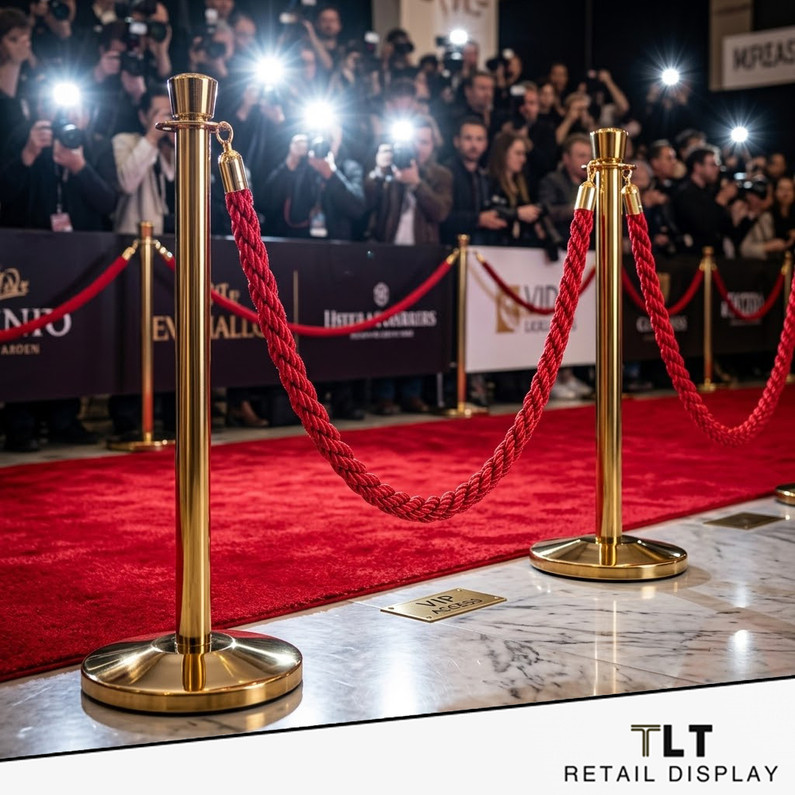
Rope barriers use a weighted post (stanchion) with a natural-fibre twisted rope connecting each post via spring-clip hooks. They have a more premium, classic aesthetic than belt barriers — which is why you typically see them at hotel entrances, fine dining restaurants, galleries, cinemas, and luxury retail environments.
Our rope barriers use a high-quality twisted natural rope — not the synthetic or velvet-style ropes that look affordable in photos but develop a worn, tired appearance very quickly. We don't sell velvet rope because after extended use the surface texture degrades and looks cheap. Natural twisted rope retains its texture and structure for far longer.
Classic rope barrier — standard setup
The classic rope barrier is a great entry point for hospitality and retail environments that want a more elegant look without the budget of a full premium setup. The 32 cm base diameter gives it solid footing, and the 1.5 m rope length suits most standard corridor or entrance configurations.
| Post weight | 5.8 kg |
| Base diameter | 32 cm |
| Base construction | Metal casing with concrete fill |
| Rope diameter | 28 mm twisted natural rope |
| Rope length | 1.5 m |
| Best for | Hotel lobbies, restaurants, boutiques, galleries |
Premium rope barrier — for high-traffic permanent installations
The premium rope barrier steps up in every dimension. The wider base (35 cm), heavier overall weight, and reinforced steel construction are designed for venues where barriers stay in place permanently and see hundreds of people passing by every day. The thicker rope (32 mm vs 28 mm) has a more substantial feel when people grab it, which reduces wear on the spring clips over time. The base bolts use a larger diameter thread — meaning they tighten properly and hold firm, unlike thinner hardware that works loose over weeks of use.
| Base diameter | 35 cm |
| Base construction | Heavy metal casing with concrete fill |
| Steel wall thickness | 1.1 mm — heavier gauge for long-term durability |
| Rope diameter | 32 mm twisted natural rope |
| Rope length | 2 m |
| Best for | Airports, cinemas, high-traffic retail, permanent lobby installations |
A word on plastic-base barriers
You'll find plenty of barriers online — and at some lower-price retailers — that use a hollow plastic base. Some come pre-filled with sand, others require you to fill them yourself with water or sand. The appeal is obvious: they're cheap to manufacture and cheap to ship.
But plastic bases have a fundamental structural problem that goes beyond just weight. When you mount the post through the base and tighten the bolt underneath, plastic simply doesn't have the rigidity to hold the thread under tension. No matter how large a washer you use, the plastic compresses or cracks slightly at the mounting point — meaning the bolt never truly tightens. Over time, the post loosens, the base rocks, and the barrier leans. If you've ever seen a row of barriers looking like they're slowly falling asleep, this is almost always the reason.
A metal-cased base with concrete fill solves this completely: the bolt has a solid material to bite into, the mounting stays tight, and the post stays vertical no matter how many times it gets nudged.
Why we don't sell the cheapest option
TLT Retail Display has been supplying professional crowd control and retail display products in Australia for over 10 years. In that time, we've learned exactly which parts of a barrier can be engineered more efficiently — and which cannot be compromised without the product failing in real-world use.
We stock budget options where they make sense (our Standard Retractable is genuinely the right tool for low-frequency event use). But we won't sell a product we know is structurally defective just because it has a lower price point. A barrier that tips over, leans, or wears out after three months isn't a barrier — it's a liability.
That's the difference you're buying when you choose TLT: products selected by people who use and understand them, not just sourced to hit a price.
Final decision guide
| If you need… | Choose |
|---|---|
| Lightweight barriers for exhibitions and events | Standard Retractable |
| Daily retail or commercial queue management | Premium Retractable |
| Upscale look for hospitality or boutique retail | Classic Rope Barrier |
| High-traffic permanent venue (airport, cinema, large retail) | Premium Rope Barrier |
Retractable Belt Barriers
Standard & Premium · 2 m or 3 m belt · Bulk pricing available
Shop retractable barriers →Rope Barriers & Stanchions
Classic & Premium · Gold, silver, black · Natural twisted rope
Shop rope barriers →Recent Posts
-

Learn how Australian retailers display posters professionally — the right frames, sizes, heights and locations to make your in-store signage work harder
Retail Tips · TLT Retail Display How to Display Posters Professionally in a Retail Store May 2026 …27th May 2026 -
Retractable Belt Barriers vs Rope Barriers: Which One Do You Need?
Buying Guide · TLT Retail Display Retractable Belt Barriers vs Rope Barriers: Which One Do You Ne …26th May 2026 -

How to Choose the Right Snap Frame Size
Buying Guide · TLT Retail Display How to Choose the Right Snap Frame Size for Your Business May 20 …25th May 2026