
Poster Stands & Floor Sign Holders
Floor standing poster stands — also sold as sign stands, floor sign holders, display stands, pedestal signs or pavement signs — for putting a printed sheet at eye level without anybody having to hold it.
Indoors, the base is already heavy and takes up no more floor than it has to. Outdoors, the base is one you fill with water on the day, or a frame that folds low and wide so the wind has nothing to catch. Getting that choice right matters more than anything else on this page.
Posters load through a snap-open frame, a slide-in channel, a magnetic panel or a clamp that grips a printed board — each product page says which, and it is what you will care about if the print changes every week.
Single or double sided, in a range of sizes and finishes.
Wholesale and retail · Indoor and outdoor · Scroll down for how to choose
- Product
- Qty in Cart
- Quantity
- Price
- Subtotal
-


A3 Gold AB Floor Poster Stand - Adjustable Tilt Pedestal Sign Holder
TLT Retail Display
$68.00This is the A3 stand in gold. The same stand also comes in black and$68.00 -


A3 Black AB Floor Poster Stand - Adjustable Tilt Pedestal Sign Holder
TLT Retail Display
$68.00This is the A3 stand in black. The same stand also comes in gold and$68.00 -
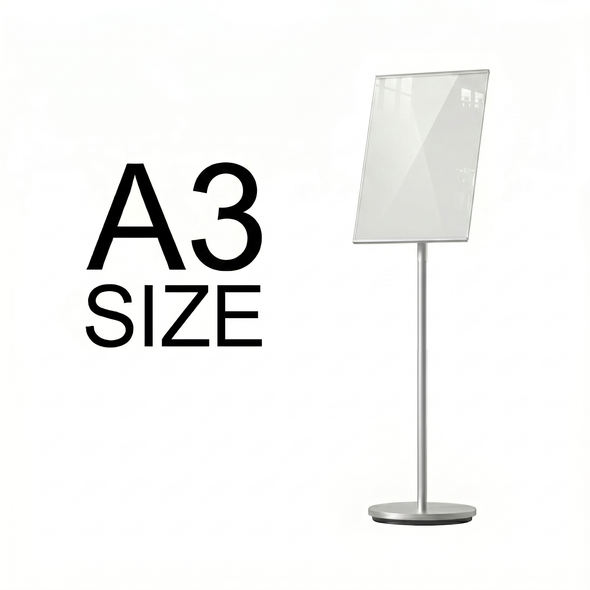
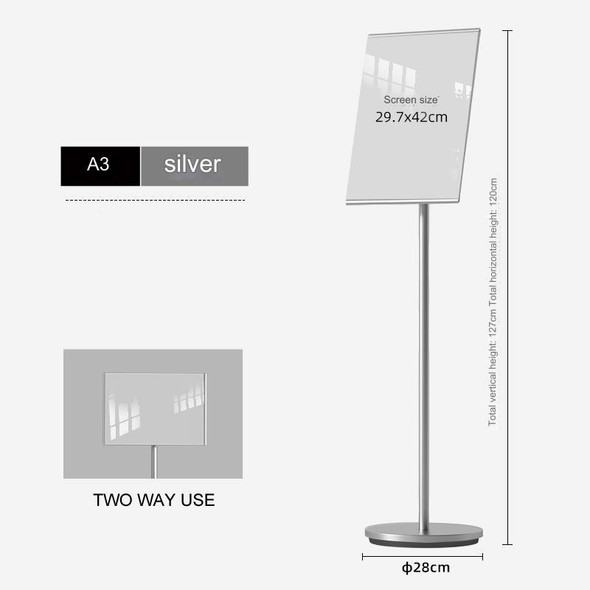
A3 Silver AB Floor Poster Stand - Adjustable Tilt Pedestal Sign Holder
TLT Retail Display
$68.00This is the A3 stand in silver. The same stand also comes in black and$68.00 -


A3 A4 AB Floor Poster Stand - Adjustable Tilt Pedestal Sign Holder, Black Gold Silver
TLT Retail Display
$58.00 - $68.00Pick the size and colour from the drop-down above. Each one also has its own page: A4 black,$58.00 - $68.00
Poster stand, sign stand, pavement sign — what to call it
This category gets searched under a lot of names: poster stand, sign stand, floor sign holder, sign holder stand, display stand, pedestal sign, poster display stand, sidewalk sign, pavement sign, A-frame, A-board, sandwich board, menu lectern, easel. They are not all the same thing, but they all do one job — hold a printed sheet upright, at eye level, without anybody having to hold it.
What separates them is three decisions, and they are worth making in this order.
1. Is it going outside?
This is the decision that matters most, and the one most often got wrong. Wind loading on a flat panel is far higher than it appears, and a base that is perfectly stable indoors will not hold the same sign outdoors.
Outside you want a base you can weight on the day — a water-fillable base, or a folding A-frame that sits low and wide. Fill it when you put it out, empty it when you bring it in, and it travels light the rest of the time. Some have wheels, because a filled base is not something you want to carry.
Inside you want the opposite: a compact weighted base that is already heavy, takes up no footpath, and does not need filling. These are for foyers, counters, aisles and reception areas, where the only force acting on the sign is someone brushing past it.
An indoor stand used outdoors will not stay upright in wind. An outdoor stand used indoors takes up more floor area than the job requires.
2. How does the poster go in?
If you change the poster weekly, this is what you will care about on day thirty.
- Snap frame. The four edges flip open, you drop the poster in, snap them shut. Fastest to change, and you do it with the stand still standing. This is what retail uses when the promotion changes every week.
- Slide-in channel. The print slides down a channel from the top. No moving parts to break, but you need clearance above the stand to load it.
- Magnetic or clip-on panel. The front lifts off or the cover is held by magnets. Good for thicker inserts and for menus that get swapped between sittings.
- Board holder. No frame at all — clamps or uprights that grip a corflute or cardboard board at the edges. This is for printed boards rather than paper posters.
3. One side or two?
Stand where your customer will be standing and look at the spot. If they only ever approach from one direction — the stand is against a wall, a window, a counter — single-sided is the right answer and costs less to print for.
If the stand sits out in open floor, in a corridor, or on a footpath where people come from both ends, double-sided earns its keep immediately. You are paying for one base and getting two faces. The usual mistake is buying single-sided for an open floor and then finding half your traffic walks past the blank side.
What size do I need?
Work backwards from how far away the reader is standing, not from what looks impressive.
- A4 is read at arm's length — a counter, a table, a queue where people are already standing still.
- A3 is read from a few paces — beside a doorway, next to a display, at the end of an aisle.
- A2 is read across a room, and is the usual size for a floor stand that has to compete with everything else in a shop.
- A1 is read from across a car park or the far side of a foyer. This is the size for footpaths and entrances.
Posters in this range are standard A sizes, so a print shop file or an office printer file drops straight in with no trimming. Each product page lists exactly which size that stand takes.
Poster stand FAQ
Will it blow over outside?
Not if you weight it. An outdoor stand is designed to be filled with water or sand on the day and emptied when it comes in — left unfilled, the base provides no resistance at all. A folding A-frame is the other outdoor answer: it sits low and wide and has nothing tall to catch the wind. Never leave any sign out in a storm, and bring it in overnight.
Can I use an indoor stand outside?
For an hour on a still day, under cover, nobody will stop you. As a permanent arrangement, no — the base is not built to be weighted further, and the frame and print are not made for rain and sun.
How do I change the poster?
Depends on the stand. A snap frame opens on all four edges and takes seconds. A slide-in channel loads from the top. A magnetic panel lifts off. The product page says which. If the print will change often, a snap frame is the one to choose.
What is corflute?
Corrugated plastic board — the lightweight fluted sheet that printed signs are usually made from. It is stiffer than paper, survives weather, and is what board-holder stands are designed to grip. If your printer is quoting you on "corflute" or "coreflute", that is this.
Do I need to print anything special?
No. Standard A-size paper or board works. Keep important wording away from the very edge, because a frame or channel overlaps the print slightly on each side — each product page gives the visible area.
Can I move it once it is set up?
Indoor weighted stands are made to be picked up and repositioned by one person. Outdoor water-filled bases are not — empty them first, or buy one on wheels if it is going to move every day.
Does it come assembled?
Most arrive flat and go together with a few screws or a push-fit, in a couple of minutes, no tools beyond what is in the box. The product page says if a stand needs more than that.
Can I put my own board or artwork in?
Yes, as long as it is the right size and thickness. Frames have a limit on how thick an insert they will close on; board holders are the opposite and want something rigid. If you are mounting something unusual, ask us first and we will tell you what will hold it.
How is delivery charged?
Each product page shows how that stand is sent. Large stands go by courier rather than post. For some regional and remote postcodes the checkout cannot calculate a cost — if that happens, contact us and we will send a courier quote before you pay. There is no obligation to go ahead.
What else should I look at?
For footpaths and shopfronts, the A-frame and pavement signs. For menus, wine lists and wayfinding on a pedestal, the menu stands and information lecterns. For wall-mounted posters rather than floor-standing, the snap frames and poster displays, and the floor standing snap frame stands if you want the same snap-open frame on legs. For counters and promotional displays, the POS and retail promotion range. Everything floor-standing is in floor standing menu and catalogue stands.